Xiaoying Song

Hi, I’m Xiaoying, a Ph.D. Candidate in Data Science at the University of North Texas, advised by Dr. Lingzi Hong. Prior to joining UNT, I received my M.S. degree in Information Science from Central China Normal University in 2023. My work has appeared at NLP and information science venues including EMNLP, NAACL, COLING, and COLM, as well as in journals such as Journal of Information Science, Journal of Informetrics, and Machine Learning.
I work on Large Language Models and Natural Language Processing, centered on two questions: how agents collaborate with humans and with each other, and how they personalize to the user in front of them. I design multi-agent pipelines with humans in the loop and adapt model behavior to each user, from reading level to safety, using RAG, RL, PEFT/LoRA, and quantization-aware training. I target high-stakes applications where trust decides whether a system ships: content moderation, misinformation response, and crisis communication. My work spans three areas:
Human–Agent Collaboration
Multi-turn conversation optimization and multi-agent coordination for complex, evolving tasks.
Personalized Alignment
User-centered dialogue systems and safety alignment that adapts to who the user is.
Computational Social Science
Language technologies for healthier online discourse: countering misinformation and supporting crisis response.
News
| Aug 23, 2026 | Three papers were accepted to EMNLP 2026. 🎉 |
|---|---|
| May 06, 2026 | Our team won second place in the CLEF CheckThat! 2026 competition. 🥈 |
| Apr 23, 2026 | I delivered a tutorial for the 2026 ASIS&T IDEA program on AI-assisted communication. 🧑🏫 |
| Apr 13, 2026 | I defended my Ph.D. qualifying exam and became a Ph.D. candidate. 🎓 |
| Nov 10, 2025 | “Speaking at the Right Level” got Honorable Mention in ASIS&T SIG-SM Student Competition. 🏅 |
Selected Publications
- EMNLP
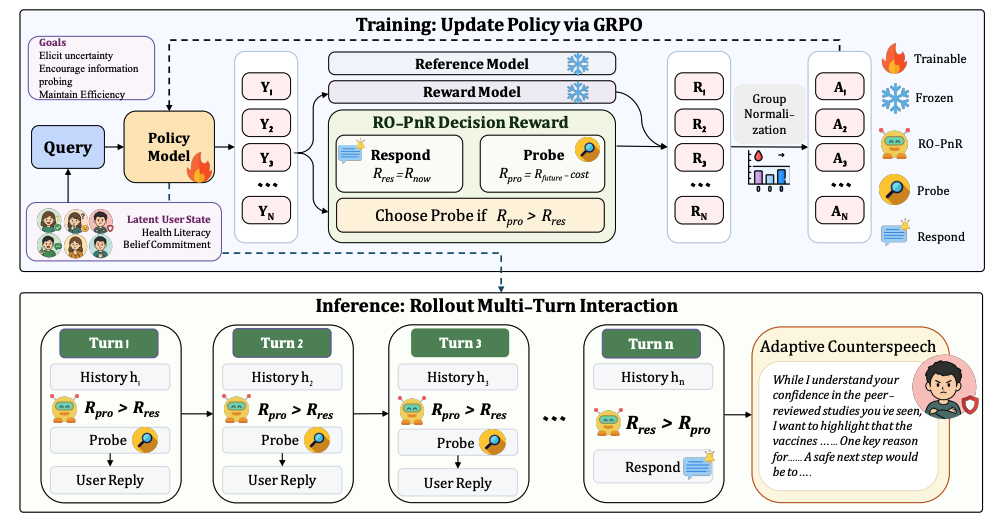 Ask or Answer: A Decision Framework for Multi-Turn Health Misinformation InterventionIn Conference on Empirical Methods in Natural Language Processing, 2026Proposes RO-PnR (Reward-Optimized Probe-and-Respond), which decides at each turn whether to probe for more information or commit to a final correction, guided by a turn-level reward weighing a probe’s expected information gain against its interaction cost. Achieves the highest cost-adjusted utility across three health-misinformation datasets and three base models while using 30% fewer turns than always-probe baselines.multi-turn dialogue clarifying questions reward optimization
 - Preprint
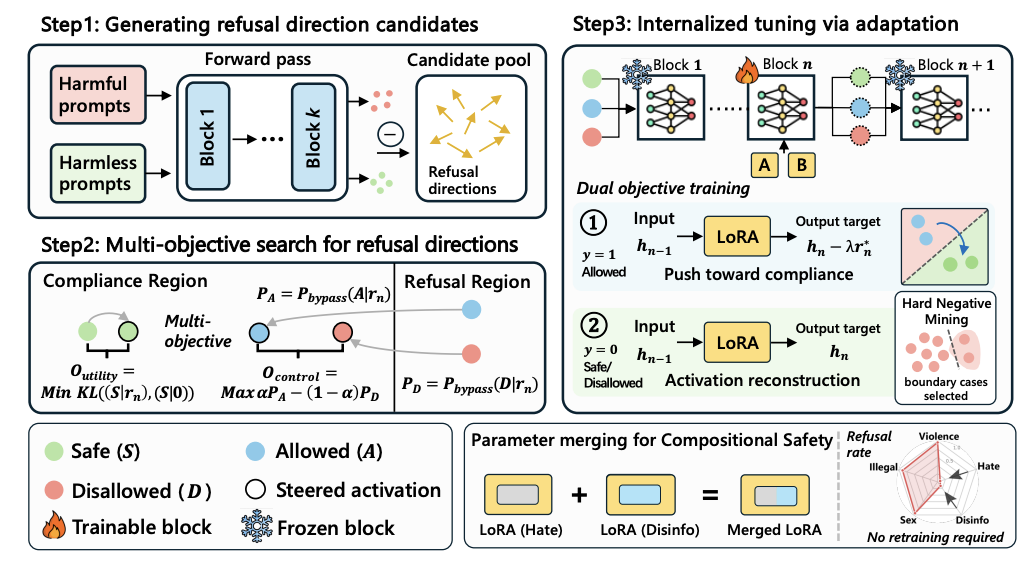 Palette: A Modular, Controllable, and Efficient Framework for On-demand Authorized Safety Alignment Relaxation in LLMsarXiv preprint arXiv:2605.24154, 2026 PDFProposes Palette, a framework that selectively relaxes LLM refusal behavior in authorized professional domains while preserving safety elsewhere, combining refusal-direction search, lightweight adaptation, and parameter merging for multi-domain composition without retraining.safety alignment refusal behavior model merging controllability
 - EMNLP
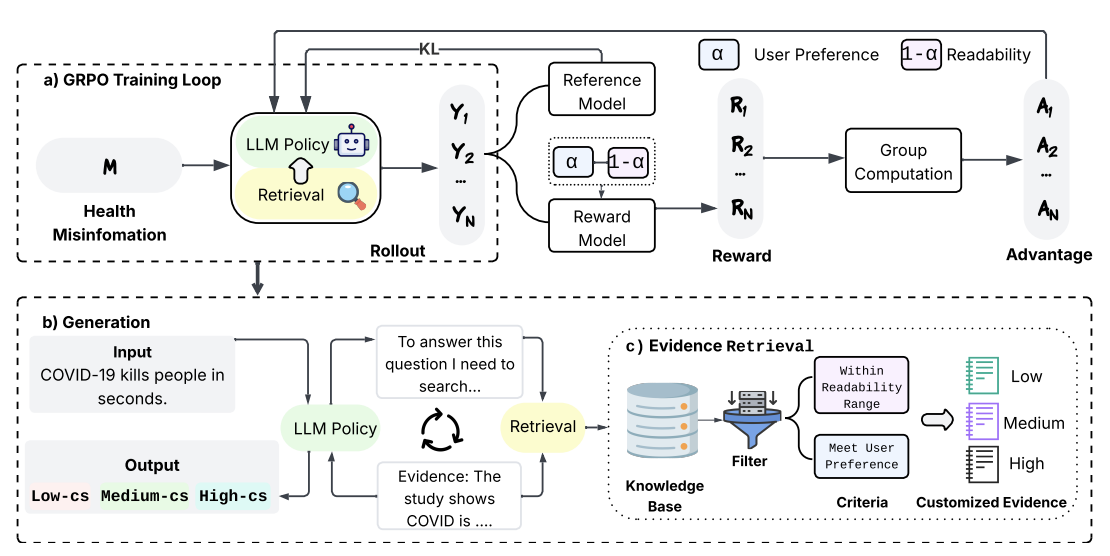 Speaking at the Right Level: Literacy-Controlled Counterspeech Generation with RAG-RLIn Conference on Empirical Methods in Natural Language Processing, 2025 PDFProposes Controlled-Literacy, a RAG plus reinforcement learning framework that generates counterspeech to health misinformation tailored to the audience’s health literacy level, producing more accessible and preferred counterspeech than baselines.readability alignment health misinformation RAG reinforcement learning
 - EMNLP
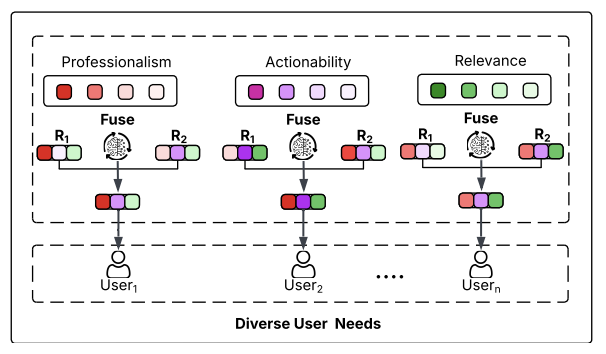 A Dynamic Fusion Model for Consistent Crisis ResponseIn Conference on Empirical Methods in Natural Language Processing, 2025 PDFIntroduces a metric for style consistency in automated crisis responses and a two-stage fusion approach that scores candidate responses and integrates them at the instance level, improving both response quality and stylistic uniformity across datasets.crisis communication style consistency text generation model fusion
 - COLM
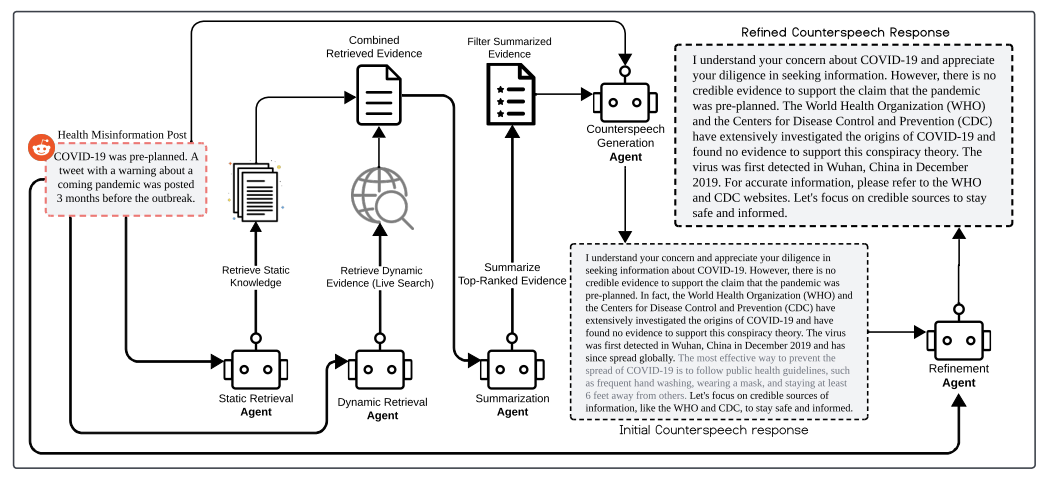 Multi-Agent Retrieval-Augmented Framework for Evidence-Based Counterspeech Against Health MisinformationIn Conference on Language Modeling, 2025 PDFPresents a multi-agent retrieval-augmented framework that combines static and dynamic evidence to generate counterspeech against health misinformation, outperforming baselines in politeness, relevance, informativeness, and factual accuracy.dialogue system health misinformation multi-agent systems RAG
 - NAACL
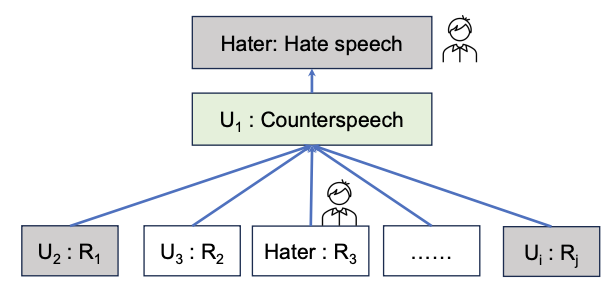 Echoes of Discord: Forecasting Hater Reactions to CounterspeechIn Nations of the Americas Chapter of the Association for Computational Linguistics, 2025 PDFStudies whether counterspeech leads haters to reenter conversations and whether reentry stays hateful, introducing ReEco, a dataset of triple-turn Reddit conversations, and linking counterspeech language to hater reactions.response effectiveness hate speech user behavior prediction